
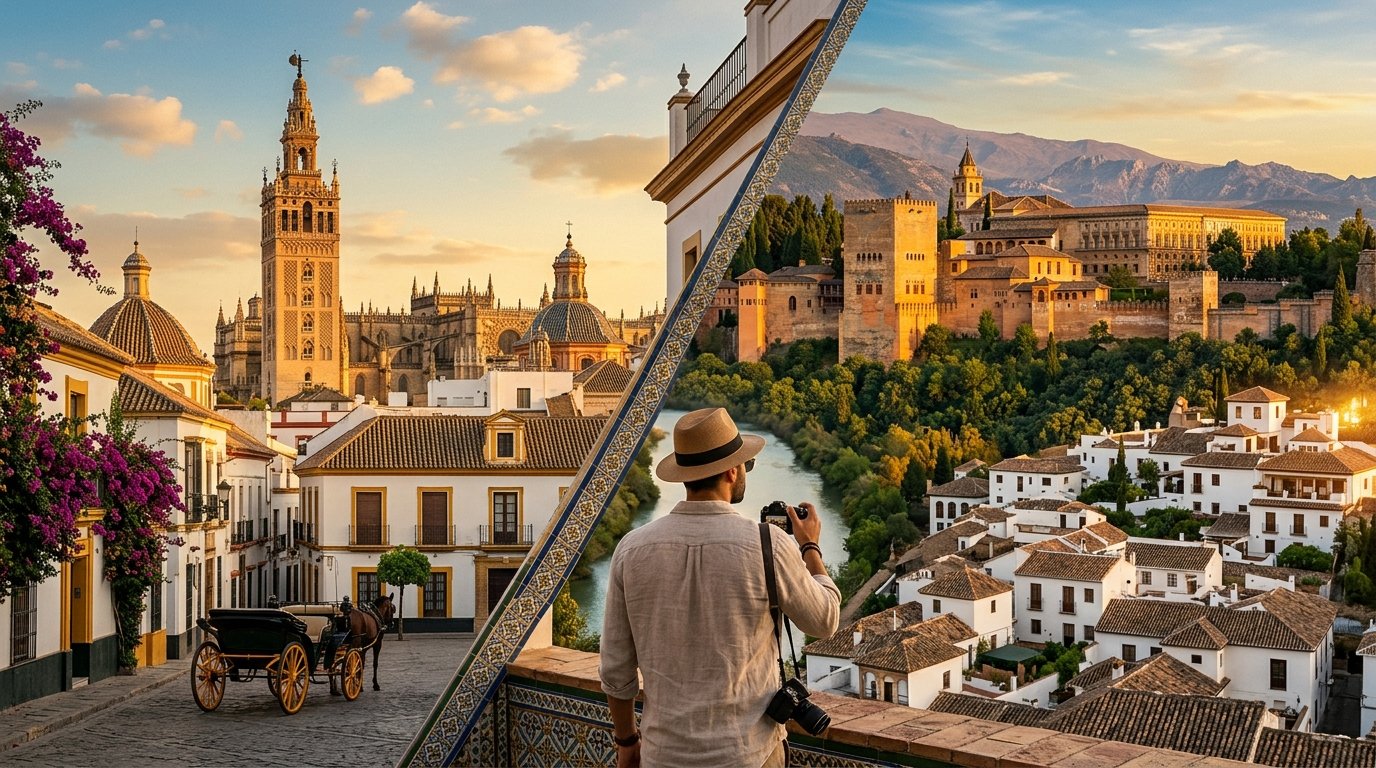
Choosing between Seville and Granada for a 2026 trip hinges on your travel style: visit Seville for vibrant urban energy and architectural grandeur, or Granada for profound historical immersion and intimate scale centered on the Alhambra. For a complete Andalusian experience, visiting both is ideal.
What Defines the Essential Character and Atmosphere of Each City?
Seville and Granada are the twin hearts of Andalusia, yet they beat to profoundly different rhythms. Separated by just 250 kilometers, they offer distinct narratives of Spanish history, culture, and daily life. Your preference will shape your entire 2026 journey.
Seville, the capital of Andalusia and Spain’s fourth-largest metropolitan area with over 1.5 million residents, is a confident, outgoing metropolis. Its identity is a palimpsest of empires: a significant Roman port (Hispalis), a flourishing Islamic Taifa kingdom after 712 AD, and the prosperous nerve center of Spain’s global empire following the 1492 discovery of the Americas. This legacy of continuous importance is felt in its grand plazas, bustling streets, and relentless calendar of festivals. Seville is a living, working city where Baroque churches stand beside modern tapas bars, and history is actively woven into the fabric of contemporary life. The pace is energetic, the spirit is festive, and the scale is undeniably urban.
Granada, with a population of approximately 230,000, is an introspective city forever defined by an ending. It was the final bastion of Islamic Spain, with the Nasrid Kingdom surrendering to the Catholic Monarchs on January 2, 1492—ending nearly 781 years of Muslim rule in Iberia. This poignant history imbues the city with a sense of romance, scholarly reflection, and melancholy beauty. The physical and spiritual core is the Alhambra, a site that attracted over 3.2 million visitors in 2024. Granada’s atmosphere is contemplative and intimate, focused on its monumental past and dramatic natural setting against the Sierra Nevada mountains, which peak at 3,479 meters. It feels less like a major city and more like a sprawling, historic campus centered around a single, world-altering monument.
The following table delineates their core identities to aid your 2026 decision:
| Category | Seville | Granada |
|---|---|---|
| Core Vibe & Atmosphere | Energetic, cosmopolitan, festive, and self-assured. A dynamic metropolis where commerce and celebration coexist. | Intimate, scholarly, romantic, and serene. A city where history whispers from every cobblestone, dominated by its alpine backdrop. |
| Historical Narrative | A crossroads of empires: Roman, Islamic, and the Catholic Atlantic Empire. The launch point for New World voyages. | The last capital of Al-Andalus. A 250-year Nasrid dynasty legacy, ending with the Reconquista’s final, poignant act. |
| Urban Layout & Geography | Largely flat, built around the Guadalquivir River. Features expansive parks, wide avenues, and extensive pedestrian zones. | Extremely hilly, structured on three primary hills. A maze of steep, cobbled lanes requiring sturdy footwear. |
| Cultural Pulse | Birthplace of flamenco’s “cante jondo.” Home to major opera, theaters, and relentless street performances. A year-round festival calendar. | Intimate “zambra” flamenco in Sacromonte caves. A prestigious university founded in 1531. Quieter, literary, and academic evenings. |
| Ideal Traveler Profile | Urban explorers, festival lovers, architecture enthusiasts, foodies, and those seeking a packed, diverse itinerary with vibrant nightlife. | History buffs, romantics, hikers, photography enthusiasts, and travelers wanting deep, focused immersion in a singular historical narrative. |
| Minimum Recommended Stay | 3 full days (4 days allows for day trips to Roman Italica or Córdoba’s Mezquita). | 2 full days (3 days permits a thorough Alhambra visit and relaxed exploration of Albaicín and Sacromonte). |
| Projected Overnight Visitors (2026) | Approximately 3.8 million, reflecting its status as a major business and leisure hub. | Approximately 2.7 million, with an estimated 70% being international visitors drawn by the Alhambra. |
| Critical 2026 Planning Note | Book accommodation 6-9 months ahead for Semana Santa (March 22-29) and Feria de Abril (April 22-27). Hotel prices can triple. | Secure Alhambra “Nasrid Palaces” timed tickets online exactly at 12:00 PM CET three months before your visit date. No exceptions. |
The cities are well-connected by frequent ALSA bus services, with a journey time of about 3 hours and 15 minutes. Projected 2026 one-way fares range from 18 Euros for standard advance bookings to 35 Euros for last-minute purchases. The high-speed train (AVE) requires a connection in Antequera, taking over 3.5 hours and costing approximately 45-60 Euros. For travelers with 7 to 8 days, combining both into a single Andalusian itinerary is highly feasible and recommended, offering a comprehensive taste of the region’s dual soul.
How Do the Architectural and Historical Landmarks Compare?
The architectural treasures of Seville and Granada are both UNESCO World Heritage Sites, but the nature of the visitor experience differs radically. Seville’s monuments are integrated into its urban fabric, often stumbled upon while wandering. Granada’s Alhambra is a destination requiring dedicated pilgrimage—a day-long immersion in a secluded hilltop complex.
Seville: A Living Tapestry of Imperial Ambition
Seville’s landmarks proclaim its historical role as a center of wealth, faith, and global power. The Cathedral of Saint Mary of the See is the world’s largest Gothic church by volume. Constructed from 1401 to 1506 on the site of the city’s 12th-century Almohad mosque, it was a profound statement of Christian triumph. Its preserved minaret, the Giralda, stands 97.5 meters tall and is a masterpiece of Islamic architecture, later crowned with a Renaissance bell tower. Inside, the monumental tomb of Christopher Columbus directly links the cathedral to the Age of Discovery. A 2026 general admission ticket, which includes access to the Giralda, is projected to cost 14.50 Euros. Book online 2-3 days in advance for peak seasons.
Adjacent lies the Royal Alcázar, a stunning palimpsest of regal power. While its foundations are Islamic, its crowning glory is the 14th-century Palacio de Don Pedro, built by Christian King Peter I using Muslim craftsmen from Granada. This created the Mudéjar style—Islamic art executed under Christian rule—seen in sublime details like the intricate stucco of the Patio de las Doncellas. It remains the oldest royal palace in Europe still in use. Booking online 7-14 days ahead for its projected 15 Euro entry in 2026 is crucial.
Beyond these giants, the Plaza de España, built for the 1929 Ibero-American Exposition, is a breathtaking half-mile crescent of Renaissance Revival architecture adorned with tiled alcoves representing each Spanish province. The Metropol Parasol (“Las Setas”), completed in 2011, offers a modern wooden structure with a 5 Euro rooftop walkway providing views over preserved Roman ruins below. The Museo de Bellas Artes, housed in a former convent, holds Spain’s second-finest collection of paintings after the Prado, featuring works by Seville-born Baroque masters like Murillo, all for a modest 3 Euro entry.
Granada: The Alhambra’s Universe and Its Echoes
The Alhambra is not merely Granada’s top attraction; it is the city’s defining essence. This “Red Fortress” is a sprawling 26-acre complex representing the final, exquisite flourish of Nasrid Islamic architecture in Spain. The Nasrid Palaces are the heart, where the mathematical harmony of the Patio de los Leones fountain and the intricate tilework of the Hall of the Ambassadors reach an artistic zenith. The Generalife Gardens, the sultan’s summer retreat, offer a serene vision of paradise with precise water channels and panoramic viewpoints.
A 2026 “Alhambra General” day ticket, covering the Nasrid Palaces, Alcazaba fortress, and Generalife, is officially priced at 22.27 Euros. The critical logistical imperative: timed entry slots for the Nasrid Palaces sell out within hours—often minutes—of release. Tickets are released at 12:00 PM Central European Time exactly three months prior to the visit date. For a visit on June 10, 2026, you must be ready to book on March 10, 2026. Consider authorized tour operators as a backup if official slots are gone.
The city’s other sites exist in the Alhambra’s shadow but complete the historical narrative. The Albaicín quarter, a UNESCO-listed labyrinth of white-washed houses, leads to the Mirador de San Nicolás and its legendary, free sunset view of the Alhambra. The Royal Chapel (5 Euros), adjacent to the cathedral, houses the marble tombs of Ferdinand and Isabella, providing a solemn Christian counterpoint. The Corral del Carbón, a 14th-century Nasrid grain exchange, is a free-entry gem showcasing Moorish commercial architecture.
Which City Offers the Better Food, Tapas, and Nightlife?
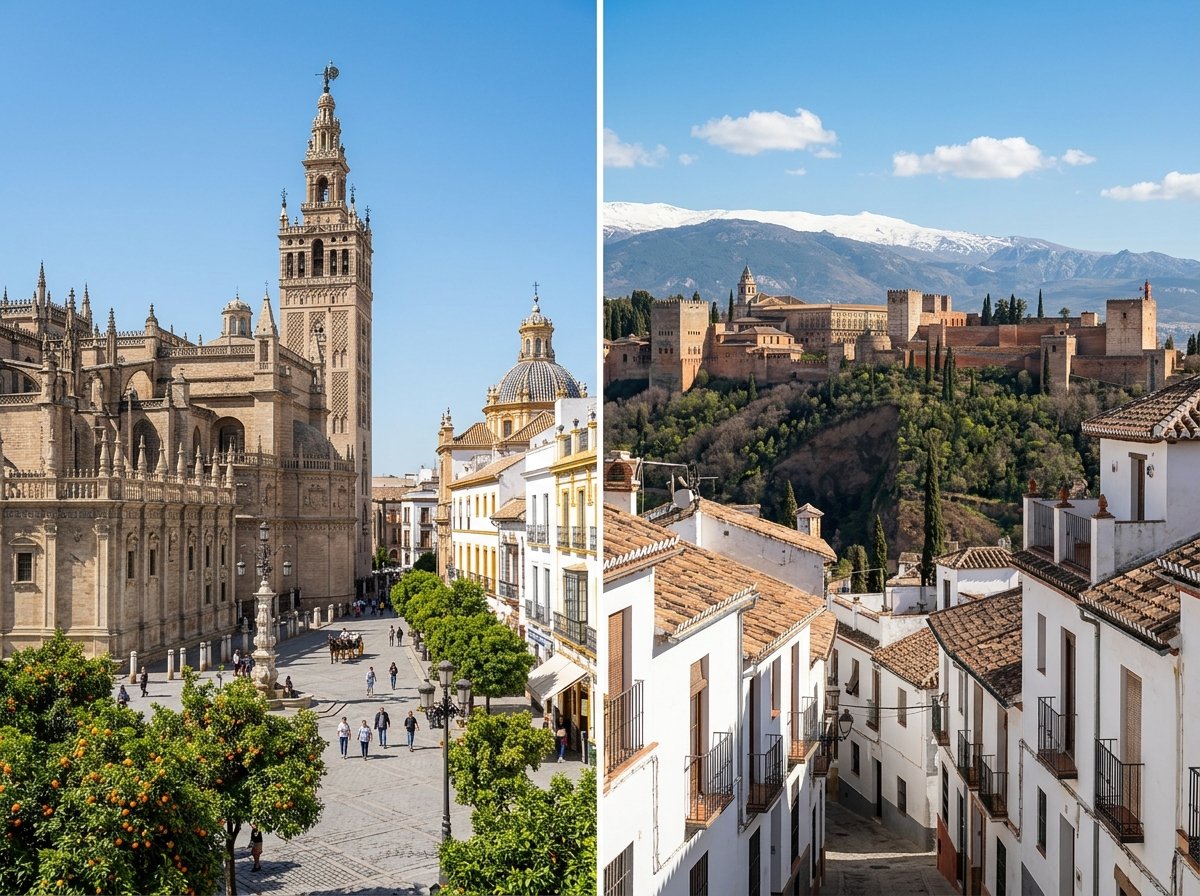
Andalusian hospitality shines in both cities, but the rules of engagement differ. Seville’s scene is diverse and culinary-driven, reflecting its metropolitan status. Granada’s is famously generous and social, built around a unique, budget-friendly tradition.
Seville: The Sophisticated Epicenter of Modern Tapas
Seville is a gastronomic powerhouse where tapas culture is an art form of constant innovation. The norm is ordering inventive, high-quality tapas and “media raciones.” Neighborhoods like Triana and El Arenal specialize in local classics: *espinacas con garbanzos* (spinach with chickpeas), *solomillo al whisky* (pork loin in whisky sauce), and exquisite *pescaíto frito* (fried fish). The city boasted eight Michelin-starred restaurants as of the 2025 guide. For authentic markets, the Mercado de Triana and Mercado de la Feria are essential stops.
Nightlife is vibrant and multifaceted. Professional flamenco tablaos like El Palacio Andaluz offer shows starting at 35 Euros, while chic rooftop bars provide views of the Giralda. The Alameda de Hércules area buzzes with eclectic bars and clubs where activity often continues past 6:00 AM. The city’s cultural calendar, like the Bienal de Flamenco, also infuses the nightlife with specialized performances.
Granada: The Legendary Realm of the Free Tapa
Granada operates on a beloved, budget-friendly system: order any drink (a 2.50 Euro glass of local wine or a beer) and you receive a complimentary, often substantial, tapa. This is not a choice but a standard practice. The tapa evolves with each round, from olives to dishes like *habas con jamón* (broad beans with ham) or *berenjenas con miel* (fried eggplant with honey). Key zones include Calle Navas and Plaza Bib-Rambla. For a unique cultural experience, the Sacromonte district offers “zambra” flamenco shows in historic cave dwellings, a more raw and intimate performance than Seville’s theatrical tablaos, with tickets around 25-30 Euros. Granada’s nightlife is quieter overall, focusing on tapas bar crawls and student pubs.
What Are the Must-See Cultural Events and Festivals in 2026?
Both cities host iconic events that can define your 2026 travel experience. Planning around these requires strategic booking but offers unparalleled cultural immersion.
Seville’s Festival Calendar: A Year-Round Spectacle
The city’s cultural year is dominated by two world-famous events. Semana Santa (Holy Week, March 22-29, 2026) is a solemn, breathtaking procession of elaborate religious floats. Accommodation and viewing spots sell out almost a year in advance. Immediately following is the Feria de Abril (April 22-27, 2026), a week-long explosion of joy with over 1,000 marquees, flamenco dresses, and daily horse parades. Booking hotels for these periods 9-12 months ahead is non-negotiable.
Other notable 2026 events include the Bienal de Flamenco (September 2026), a prestigious month-long festival. The Festival de las Naciones (April to May 2026) in Parque de María Luisa offers international food and cultural stalls.
Granada’s Cultural Highlights: Intimacy and Tradition
Granada’s festivals are often more atmospheric and locally focused. The Corpus Christi celebration (June 4, 2026) features beautiful processions. The International Festival of Music and Dance (late June to mid-July 2026) holds performances in the magical settings of the Alhambra’s Generalife gardens, with tickets selling quickly upon release in spring 2026. The Día de la Cruz (May 3, 2026) fills squares with flower-adorned crosses. The Feria de Granada (late September 2026) is a more local version of Seville’s April Fair.
Is Seville or Granada More Budget-Friendly for a 2026 Trip?
While both are generally more affordable than Madrid or Barcelona, there are distinct differences in cost structure and ease of navigation that impact 2026 trip planning.
Accommodation, Dining, and Daily Expenses
Average nightly rates for a central 3-star hotel in 2026 are projected to be 115-150 Euros in Seville, compared to 100-135 Euros in Granada. Seville’s higher business and event tourism, especially during festivals, drives prices up; during Feria de Abril, rates can exceed 300 Euros per night. Granada offers superior value, particularly with its free tapa system, which can reduce daily food costs significantly. A budget-conscious traveler can enjoy a substantial meal through several drink-and-tapa rounds for under 15 Euros per person in Granada, whereas a similar tapas experience in Seville might cost 20-25 Euros.
For sit-down dining, Seville’s average cost for a three-course meal at a mid-range restaurant is projected at 25-35 Euros per person, excluding wine. In Granada, it’s 20-30 Euros. Both cities have excellent budget options: Seville’s mercados and Granada’s “menú del día” (fixed lunch menu) for 10-15 Euros.
Attraction Costs and City Navigation
Seville’s major sites (Cathedral, Alcázar) cost around 14-15 Euros each. Granada’s primary expense is the Alhambra at 22.27 Euros, but many experiences are free: wandering the Albaicín, the San Nicolás viewpoint, or the historic Alcaicería market. The Granada Cathedral costs 5 Euros, and the Royal Chapel 5 Euros. Seville’s Bellas Artes Museum remains a steal at 3 Euros.
Navigating the cities differs significantly. Seville’s historic center is largely flat and exceptionally walkable; its tram line and bike-sharing scheme are useful for longer distances. Granada’s intense topography makes walking strenuous; the city operates an efficient network of small red buses that navigate the narrow streets of the Albaicín and Alhambra hill. A 10-trip bus card (“Bonobús”) costs approximately 8.50 Euros and is highly recommended for 2026 visitors to Granada.
What Are the Best Day Trip Options from Each City?
A key advantage of basing yourself in either city is access to other iconic Andalusian destinations. The day trip opportunities reveal the different regional roles each city plays.
From Seville, you are connected to major historical sites via excellent rail and road networks. The high-speed AVE train makes Córdoba a mere 45-minute journey. Here, the breathtaking Mezquita-Catedral, a UNESCO site that is a former mosque with a cathedral built inside, is an essential visit. Further afield, the ancient Roman ruins of Itálica—the birthplace of emperors Trajan and Hadrian—are just 20 minutes by bus from Seville’s center. The white villages of the Sierra de Aracena or the sherry triangle around Jerez de la Frontera are also within a 90-minute drive, offering landscape and culinary diversity.
From Granada, day trips are more focused on nature and distinctive local culture. The most spectacular is the Sierra Nevada mountain range. In winter, the ski resort offers slopes just 45 minutes from the city center—a unique combination of culture and sport. In summer, the same area provides exceptional hiking and panoramic views. The Alpujarras region, a collection of white-washed villages clinging to the southern slopes of the Sierra Nevada, is a 75-minute drive and offers stunning hiking trails and traditional crafts. For beach lovers, the Costa Tropical (around Almuñécar) is about an hour’s drive, providing a coastal contrast to Granada’s alpine setting.
FAQ
Which city is better for first-time visitors to Spain?
For first-time visitors seeking a quintessential, vibrant Spanish experience with iconic architecture, fiery flamenco, and lively streets, Seville is often the more impactful choice. It delivers a concentrated dose of Andalusian culture. Granada is ideal for travelers with a deep interest in Islamic history and those who prefer a more contemplative, intimate atmosphere centered on one monumental site.
Can I realistically visit both Seville and Granada in one trip?
Absolutely. Given their proximity (approx. 3-hour bus ride) and the contrasting experiences they offer, combining them is highly recommended for a comprehensive Andalusia tour. A 7-8 day itinerary allows for 3 nights in Seville and 2-3 nights in Granada, providing sufficient time to explore each city’s highlights without feeling rushed.
Is one city significantly safer than the other for tourists?
Both Seville and Granada are considered very safe for tourists by European standards. Standard precautions apply: be vigilant against pickpocketing in crowded tourist areas like Seville’s Santa Cruz neighborhood or around Granada’s Cathedral. Violent crime against tourists is extremely rare in both cities.
Which city is more accommodating for travelers with mobility issues?
Seville is generally more accessible due to its predominantly flat terrain in the historic center, widespread pedestrian zones, and accessible public transport options. Granada’s intense hills, steep cobbled streets in the Albaicín, and the vast, multi-level layout of the Alhambra complex present significant challenges for those with limited mobility, though some adapted routes and transport are available.
For a 2026 visit, when should I start booking accommodations and tickets?
For Seville, especially if visiting during Semana Santa or the Feria de Abril, begin searching for accommodations 9-12 months in advance. For Granada, the primary concern is Alhambra tickets: mark your calendar to book online exactly three months before your desired visit date at 12:00 PM CET. For both cities, booking flights and general lodging 4-6 months ahead for travel in spring or fall 2026 is advised.