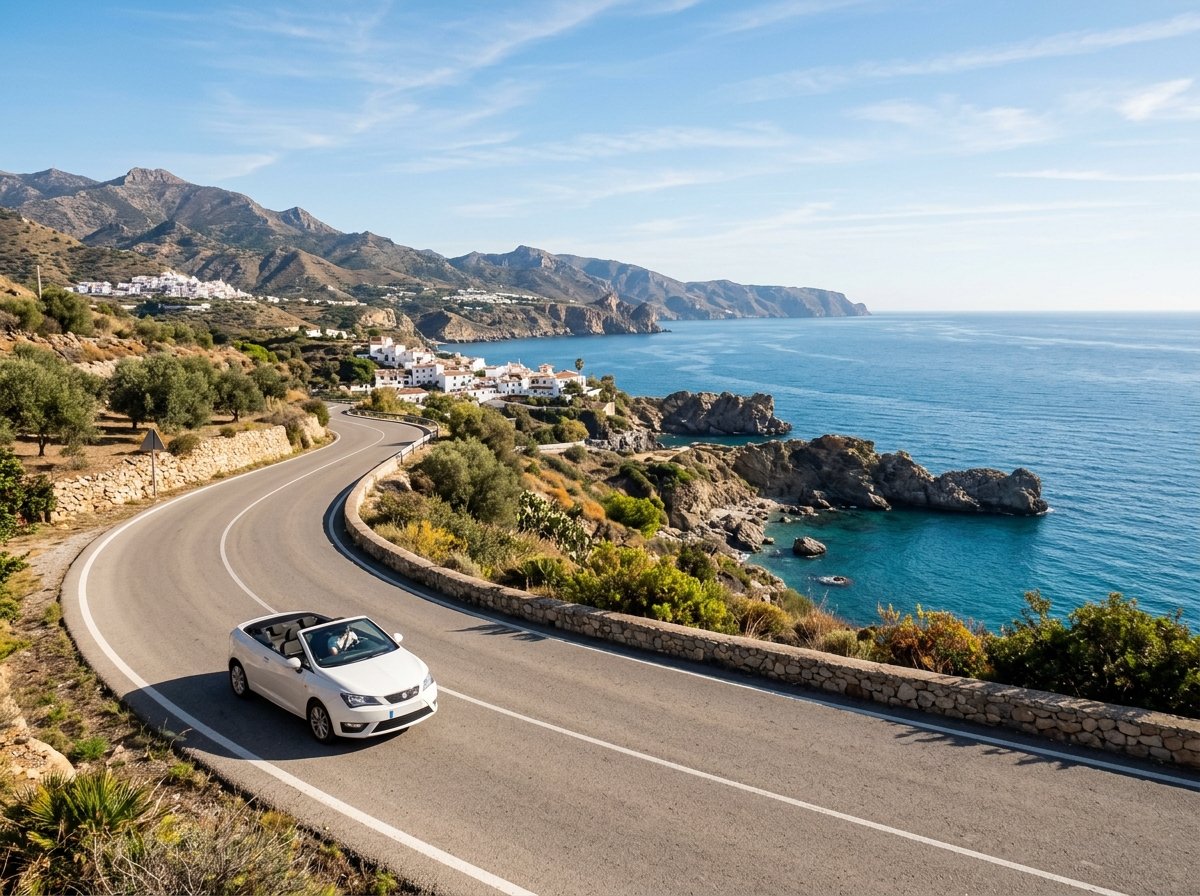
Spain Road Trip Guide 10 Days: My Expert Itinerary & Local Tips


title: “Spain Road Trip Guide 10 Days: My Expert Itinerary & Local Tips”
meta_title: “10-Day Spain Road Trip: Barcelona to Seville Drive”
meta_description: “Planning a 10-day Spain road trip? I drove this 1,500 km route myself: Barcelona, Valencia, Granada, Seville, and Madrid. Get my day-by-day itinerary, driving tips, hotel picks with parking, and real cost breakdown for 2026.”
focus_keyword: “Spain road trip 10 days”
author: “Maria Santos”
author_credentials: “Spain-based travel blogger and cultural guide writer for 8 years.”


Spain road trip route map showing 10-day itinerary from Barcelona to Madrid via Andalusia

I’ve spent eight years exploring Spain by car. I know which coastal roads are worth the detour and which small towns serve the best tapas. This 10-day Spain road trip guide is the route I recommend to friends. It balances iconic cities with quiet villages and gives you a real sense of the country’s diversity. You’ll need to move at a good pace, but I’ve built in time for spontaneous stops. That’s the magic of a road trip here.

Written by Maria Santos, Spain-based travel writer and cultural guide author for 8 years. Last updated: April 2026. Sources: Dirección General de Tráfico (DGT), Instituto Nacional de Estadística, Turespaña Official Tourism Board.

This article contains affiliate links. We may earn a commission at no extra cost to you.
Quick Answer: Can You Drive Spain in 10 Days?

Yes. A 10-day Spain road trip covering Barcelona, Valencia, Granada, Ronda, Seville, and Madrid is realistic and rewarding. You drive roughly 1,500 km total, spend 3 days without a car in Barcelona, then move every 1-2 days. Budget 2,500-3,000 Euros for two people excluding flights. Book the Alhambra 90 days ahead — it’s the only bottleneck.

StopNightsDistance InMust-Book
Barcelona3Sagrada Família
Valencia1350 kmPaella dinner
Granada2450 kmAlhambra
Seville (via Ronda)2250 kmRoyal Alcázar
Madrid1530 kmReturn flight

What Do You Need for a Spain Road Trip?

Before you book anything, get these essentials sorted. A successful road trip here depends on preparation. You’ll need a valid driver’s license from your country. If it’s not in English or Spanish, get an International Driving Permit. I’ve been asked for mine at rental counters. Your passport is non-negotiable for ID. For navigation, I never rely solely on car rental GPS. Download offline Google Maps areas for Spain. Coverage is good, but mountain passes can be tricky. Book your rental car well in advance, especially for summer trips. I use GetRentacar to compare prices across providers — Check Latest Price. Automatic transmissions cost more and sell out fast. Reserve a small to medium car. Spanish streets, particularly in old towns, are narrow. Finally, get a credit card with no foreign transaction fees and a high enough limit for the rental deposit, which can be a 1000-1500 Euro hold.

How Do You Plan the Perfect Spain Road Trip Route?

Start by booking open-jaw flights. Fly into Barcelona (BCN) and out of Madrid (MAD). This saves you a seven-hour drive back north. I did the return drive once and wasted a full day. Next, secure your rental car for pick-up in Barcelona on Day 4 of the itinerary. You don’t need a car in Barcelona. Trust me, parking is expensive and stressful. Use public transport there. Book the car from a downtown Barcelona office or the airport for a midday pickup. Choose a drop-off in Madrid city center or at the airport. Compare all-inclusive prices that include full insurance, unlimited mileage, and one additional driver. My last weekly rental for a VW Golf in May was 420 Euros. In August, that same car costs over 700 Euros.

Pro Tip: Always opt for the full coverage insurance from the rental company. It’s more upfront, but it means zero hassle if you get a scratch. Spanish roads can be tight, and door dings in parking lots are common.

What Is the Best 10-Day Spain Road Trip Itinerary?

Here is the day-by-day route I tested last spring. It covers 1500 kilometers.

Days 1-3: Barcelona. Explore without a car. See Gaudí’s Sagrada Família, the Gothic Quarter, and the Barceloneta beach. I pre-book all major attractions to skip lines.

Day-by-day Spain road trip itinerary: driving route through Valencia, Granada, Ronda, and Seville

Day 4: Barcelona to Valencia (350km, 3.5h drive). Pick up your car after breakfast. Take the AP-7 toll motorway for speed, but I prefer the coastal N-340 for views. Stop in Peñíscola for lunch. Its castle on the sea is stunning. Arrive in Valencia for a paella dinner in the old town.

Day 5: Valencia to Granada (450km, 5h drive). A long driving day. Take the A-7 then A-92 motorways inland. Stop in the white town of Baeza for a coffee break. Arrive in Granada for an evening flamenco show in the Sacromonte caves.

Day 6: Granada. No driving today. Visit the Alhambra. You must book tickets months in advance. I spent six hours there. Wander the Albayzín district in the late afternoon.

Day 7: Granada to Seville via Ronda (250km, 4h drive). This is a scenic drive. Take the A-92 to Antequera, then the A-367 to Ronda. See its famous bridge. Have lunch there before continuing to Seville.

Days 8-9: Seville. Park the car and walk. See the Cathedral, Alcázar, and Plaza de España. Get lost in the Santa Cruz neighborhood. On day 9, consider a day trip to Córdoba (1.5h each way) to see the Mezquita.

Day 10: Seville to Madrid (530km, 5.5h drive). Return the car in Madrid. If your flight is the next day, spend your last evening in the capital.

Which Attractions Should You Book in Advance in Spain?

Spain’s top sites sell out. I’ve seen tourists turned away at the gate. Book these as soon as your dates are fixed. In Barcelona, book the Sagrada Família, Park Güell, and Casa Batlló. In Granada, the Alhambra is the most critical ticket in Spain. Release times vary, but check the official website 90 days out. Generalife entry often sells out weeks ahead. In Seville, book the Royal Alcázar. A timed slot saves you from a two-hour queue. I also book flamenco shows in Granada and Seville ahead of time. Good venues fill up, especially on weekends.

Pro Tip: For the Alhambra, if the official site shows no availability, check authorized resellers like Tiqets or GetYourGuide. They buy blocks of tickets but charge a small premium. It’s worth it.

How Do Driving Rules and Tolls Work in Spain?

Driving in Spain is straightforward, but know the rules. You drive on the right. At roundabouts, vehicles already in the circle have priority. This is strictly enforced. Speed limits are 120 km/h on motorways (autopistas), 90 km/h on secondary roads, and 50 km/h in urban areas. Fines are high and can be issued on the spot. Full regulations are published by the Dirección General de Tráfico (DGT), Spain’s official road authority. You must carry two warning triangles and a reflective vest for each passenger. If you break down, put the vest on before exiting the car. Many motorways are toll roads (autopistas de peaje). They are marked with an ‘AP’ prefix. For my route, expect tolls from Barcelona to Valencia (approx. 25 Euros) and on sections near Madrid. Have coins and a credit card ready. I keep a small bag of 1 and 2 Euro coins in the cup holder. According to the Instituto Nacional de Estadística, Spain recorded over 94 million international tourist arrivals in 2024, making it the second most visited country in the world — which is exactly why pre-booking everything matters. For European road trip safety statistics, the European Road Safety Observatory at ec.europa.eu shows Spain’s motorways among the safest in the EU.

Where Should You Stay on a Spain Road Trip?

Where you stay matters as much as what you see. In cities, I book hotels with secured parking. Street parking is a nightmare. In Seville’s center, a hotel with a garage costs 25-30 Euros per night, but it’s essential. In smaller towns like Ronda or Baeza, I look for paradores (state-run hotels) or smaller hotels with their own lot. When booking, always filter for “parking available” and read reviews to confirm it’s on-site. I use Trip.com for their clear filters and guest photos — Check Latest Price. For flights into Barcelona and out of Madrid, Aviasales surfaces the cheapest open-jaw fares. For this trip, budget 100-150 Euros per night for a good 3-star hotel with parking. In Madrid or Barcelona at the start/end, I choose an airport hotel with a long-stay car park or a city hotel near a rental office.

Pro Tip: Some historic hotels have tiny garages. Call ahead to confirm your car size fits. I once had to find a public garage because my SUV was too tall for their medieval archway.

Common Mistakes to Avoid

I see travelers make these errors every season. First, trying to drive in Barcelona or Madrid city centers. It’s chaotic, and parking costs 40 Euros a day. Use the car for the cross-country legs only. Second, not booking the Alhambra. It sells out, and there is no waitlist. Your trip will be incomplete without it. Third, underestimating driving times. Google Maps doesn’t account for summer traffic on coastal roads or mandatory rest stops. Add 20% to all estimated drive times. Fourth, packing only city clothes. Comfortable walking shoes are your most important item. You’ll walk 10-15k steps daily on cobblestones. Fifth, scheduling a flight home on the same day you drive from Seville to Madrid. Any delay on the A-4 motorway could cause a missed flight. Stay in Madrid the night before.

Pro Tips From My 8 Years on Spanish Roads

Here is my local knowledge. Eat lunch between 2 PM and 4 PM. That’s when restaurants serve the fixed-price ‘menú del día’—a three-course meal with wine for 12-18 Euros. It’s the best value in Spain. For navigation, use Waze for real-time police and hazard alerts on motorways. Fill up gas at stations on the outskirts of towns. Fuel is cheaper there than on the motorway. Diesel is ‘gasóleo’. Unleaded 95 is ‘gasolina 95’. When in doubt, choose a ‘Venta’ for food. These are traditional roadside inns with simple, excellent local food. They’re marked with a blue plate on the highway. Finally, learn five basic Spanish phrases: “Hola,” “Gracias,” “La cuenta, por favor” (the bill, please), “Dos cafés” (two coffees), and “¿Dónde está…?” (Where is…?). It changes how locals interact with you.

FAQ: Spain Road Trip 10 Days

Q: Is 10 days enough for a Spain road trip?
Yes, if you focus on a clear route. This itinerary covers the northeast, east coast, and deep south. You get a rich mix but must keep to a schedule. For a more relaxed trip with more beach time, I’d recommend 14 days.

Q: What is the average cost for a 10-day road trip in Spain?
For two people, excluding flights, I budget 2500-3000 Euros. This covers a mid-size rental car with full insurance (600 Euros), 3-star hotels (1200 Euros), fuel and tolls (350 Euros), attractions (300 Euros), and food/drink (800 Euros). You can do it cheaper by staying in guesthouses and eating more tapas.

Q: Is it safe to drive in Spain?
Yes, the roads are among the best in Europe. Motorways are well-maintained. The main risks are fatigue on long stretches and narrow streets in historic towns. Drive defensively, especially around large roundabouts.

Q: Should I get an automatic or manual car?
If you’re not confident with a manual transmission, pay extra for an automatic. Spanish rental fleets are mostly manual. Automatics are limited and cost about 30% more. I book mine at least three months in advance.

Q: What’s the best time of year for this road trip?
Spring (April-May) and fall (September-October). The weather is mild, crowds are smaller, and driving is pleasant. I avoid July and August. It’s extremely hot, especially in Andalusia, and coastal roads are jammed with traffic.

Q: Can I do this trip in reverse?
Absolutely. Fly into Madrid, drive south to Seville, then work your way up to Barcelona. The driving distances and logistics are identical. I slightly prefer starting in Barcelona for the food scene.

Q: Do I need an International Driving Permit for Spain?
If your license is not in Spanish or English, yes. US, UK, and EU licenses are generally accepted without an IDP, but rental companies sometimes ask for one. I carry mine as a safety net. It costs around 20 USD and takes 10 minutes at AAA or the UK Post Office.

Q: Are Spanish motorway tolls expensive?
Tolls vary by route. Barcelona to Valencia on the AP-7 costs around 25 Euros. The AP-4 from Seville to Cadiz is about 8 Euros. Many sections are now free since the concession expired in 2021. Budget 60-80 Euros total for this 10-day itinerary. Most toll plazas accept Visa, Mastercard, and coins.

Q: What happens if I get a speeding fine in Spain?
Rental companies charge your card for the fine plus a 40-50 Euro admin fee. The DGT (Spanish traffic authority) mails the official notice to your home country within 6 months. Pay within 20 days to get a 50% discount. I’ve only been fined once — on the A-4 near Córdoba for 90 km/h in an 80 km/h zone.

For more Spain travel planning, see my guides on Barcelona vs Madrid: Which Spanish City Should You Visit First in 2026? and Best Beaches in Spain 2026: 15 Expert-Picked Shores. If you’re extending the trip, check The Complete Spain Itinerary 2026: Step-by-Step Guide for First-Time Visitors for a 14-day version.

Ronda bridge and gorge — a highlight of the Spain road trip from Granada to Seville

How to Rent a Car for a Spain Road Trip

Renting a car is the key decision that makes or breaks this itinerary. For a 10-day trip covering 1,500 km, choose a compact or mid-size car. Spanish parking garages and village streets are narrow. A VW Golf or Seat Ibiza is ideal. I always compare prices on GetRentacar — it searches 800+ car rental companies and shows the all-in price upfront.

Key rules: book at least 2-3 months ahead in summer. Choose full coverage insurance — the excess waiver is worth every euro. If two people are driving, add the second driver at booking; adding at the counter costs up to 15 Euros/day. For a detailed walkthrough, see my full guide on how to rent a car in Spain including the best pickup locations and age restrictions.

Cost snapshot: In May, a 10-day compact rental with full insurance runs 380-480 Euros. In August, the same car is 650-800 Euros. Booking early is the cheapest upgrade you can make to this trip.

Next Steps: Make Your Spain Road Trip a Reality

This guide gives you the framework I use. Now make it yours. First, check flight prices into Barcelona and out of Madrid for your dates. Use a price alert tool. Second, as soon as you have dates, book your Alhambra tickets. That is your anchor. Then, secure your rental car. Finally, book your hotels, starting with Granada and Seville, as they fill fastest. Spain is best experienced with a sense of adventure and a well-planned route. This 10-day drive has given me some of my favorite travel memories. I hope it does the same for you. For detailed guides on each city, like where to eat in Seville’s Triana district or how to skip the lines at the Sagrada Família, explore the other guides on my blog. Start planning your drive today.

Leave a Reply

Your email address will not be published. Required fields are marked *