
Spain 7-Day Itinerary for First-Timers (2026)
> Disclosure: This article contains affiliate links. If you book hotels or flights through links on this page, we may earn a small commission at no extra cost to you. We only recommend services we trust and have personally used.
—
# Spain 7-Day Itinerary for First-Timers: The Complete 2026 Guide
My first trip to Spain changed everything I thought I knew about European travel. Seven days felt impossibly short on paper — but with the right route, it’s more than enough to fall in love with this country. The classic path connects Madrid, Toledo, Córdoba, Seville, and Barcelona, and Spain’s AVE high-speed trains do most of the heavy lifting. Budget around €100–€150/day for a comfortable mid-range trip. This guide gives you every day planned, every train booked, and every euro accounted for.
Reading time: 14 minutes
—
Table of Contents
1. Is 7 Days Enough for Spain?
2. The Classic First-Timer Route
3. Day 1: Madrid — First Impressions
4. Day 2: Madrid Deep Dive + Toledo Day Trip
5. Day 3: Madrid to Córdoba
6. Day 4: Córdoba to Seville
7. Day 5: Seville Full Day
8. Day 6: Seville to Barcelona
9. Day 7: Barcelona — Final Day
10. Spain 7-Day Budget Breakdown
11. Transportation Guide: AVE Trains, Buses & Flights
12. Best Hotels for Each Stop
13. What to Pack for 7 Days in Spain
14. FAQ
—
Is 7 Days Enough for Spain? {#is-7-days-enough}
Seven days is enough to see Spain’s most iconic highlights — Madrid, Seville, and Barcelona — without feeling like you’re sprinting. The trick is using Spain’s AVE high-speed rail to move fast between cities, so you spend your actual time *there*, not on a platform. You won’t see everything. But you’ll leave with a genuine feel for the food, the architecture, and whatever it is that makes Spain so stubbornly addictive.
Most first-time visitors trip over the same mistake: too many cities. Three to four stops over seven days is the sweet spot. You actually *settle in* rather than just sleeping on trains and dragging luggage across concourses.
According to Spain’s National Tourism Institute (INE), the average first-time international visitor stays 7.3 nights. The Madrid-Seville-Barcelona triangle accounts for 68% of all first-time itineraries — there’s a reason for that. This guide follows the proven path, but adds one stop most people skip: Córdoba, Spain’s most undervisited UNESCO city.
—
What Is the Best Route for a First Time Visitor to Spain? {#the-classic-route}
The best first-time route runs along Spain’s AVE corridor — start in Madrid, head south through Córdoba and Seville, then fly up to Barcelona. Or reverse it. Either way, you’re moving in one direction with no backtracking, which is exactly what a 7-day trip needs.
The Classic First-Timer Route at a Glance:
| Day | Location | Overnight |
|—–|———-|———–|
| Day 1 | Arrive Madrid | Madrid |
| Day 2 | Madrid + Toledo day trip | Madrid |
| Day 3 | Madrid → Córdoba | Córdoba |
| Day 4 | Córdoba → Seville | Seville |
| Day 5 | Seville full day | Seville |
| Day 6 | Seville → Barcelona (flight) | Barcelona |
| Day 7 | Barcelona | Barcelona (depart) |
Why this route works:
– All cities connect by fast trains or direct flights
– You move in one direction — no doubling back
– Each city feels completely different from the last
– You hit Spain’s three biggest draws: the Prado, the Mezquita, and Sagrada Família
Alternative route (Andalusia focus): Skip Barcelona, add Granada. You get more depth in Southern Spain but lose Gaudí entirely. I cover this in the FAQ below.
—
Day 1: Madrid — Arrival, Sol, and Tapas {#day-1-madrid}
Arrive. Orient yourself. Eat a lot.
You land at Adolfo Suárez Madrid-Barajas Airport (MAD). Take Metro Line 8 directly into the city center — it’s €4.50 and takes 25 minutes. Skip the taxi unless you’ve got truly heavy luggage; the metro’s faster and you won’t get stuck in airport traffic.
Day 1 Itinerary:
– Afternoon: Check in, then walk to Puerta del Sol — the geographic center of Spain. The 0 km marker is embedded right in the pavement. From Sol, it’s a 5-minute stroll to Plaza Mayor, a 17th-century arcaded square that’s perfect for a first Spanish coffee.
– Late afternoon: Wander through the Barrio de las Letras (Literary Quarter). The streets are narrow and the pavements are carved with verses from Cervantes and Lope de Vega. It’s a bit theatrical, honestly, but in the best way.
– Evening: Head to Mercado de San Miguel for your first proper tapas spread. Order jamón ibérico, patatas bravas, and a glass of Rioja. You’ll spend €20–€30 per person and wonder why you ever ate elsewhere.
– Dinner: La Latina neighborhood, specifically Calle Cava Baja, for full-service tapas bars.
Practical notes:
– Metro single ticket: €1.50–€2.00
– Madrid tap water is excellent — bring a refillable bottle
– Restaurants don’t open for dinner until 9:00 PM. This is not a rumor. Plan accordingly.
Where to stay in Madrid: Malasaña and Chueca neighborhoods hit the sweet spot of character, safety, and price. Mid-range hotels run €80–€130/night.
Search Madrid hotels on Booking.com — prices update daily, so book early for peak season (April–June, September–October).
—
Day 2: Madrid Museums + Toledo Day Trip {#day-2-madrid-toledo}
Morning in the Prado, afternoon in a medieval city. This is one of the best day combinations in Europe.
Morning — The Prado Museum:
Open at 10:00 AM. Book tickets online (€15) to skip what can be a long queue. Focus on three rooms: Velázquez in Room 12, Goya’s Black Paintings in Rooms 65–67, and El Greco in Room 9B. Give it 2.5 hours. The Prado is genuinely one of the world’s five best painting collections — don’t rush it, and don’t try to see everything.
Afternoon — Toledo Day Trip:
Toledo is Spain’s “City of Three Cultures” — Christian, Muslim, and Jewish communities coexisted here for centuries. It sits on a rocky hill above the Tagus River, just 33 minutes from Madrid by AVE (€13–€17 each way). Going there feels like stepping into a different century. Toledo is that kind of place.
Toledo highlights:
– Toledo Cathedral (Gothic masterpiece, €10 entry)
– El Greco’s House and Museum (€3 entry)
– Alcázar of Toledo (free on weekends)
– The old Jewish Quarter (Judería) — just walk it
Trains: Renfe runs regular AVE services from Madrid Atocha to Toledo every 30–60 minutes. Book at Renfe.com for the best prices.
Return: Catch the 7:00 or 8:00 PM train back to Madrid. You’ll be back in time for a late Spanish dinner — which, as noted above, is when Spaniards actually eat.
Budget for Day 2:
– Prado ticket: €15
– Toledo train (return): €26–€34
– Toledo entry fees: €13
– Meals: €35
– Total Day 2: ~€90–€100
—
Day 3: Madrid to Córdoba — Spain’s Forgotten Jewel {#day-3-cordoba}
Córdoba is the most underrated city in Spain. Most tourists skip it. That’s a mistake.
Morning — Leave Madrid:
Take the AVE from Madrid Atocha to Córdoba. It’s 1 hour 45 minutes and tickets run €30–€55. Trains start from 6:30 AM. An 8:00–9:00 AM departure gives you a full afternoon in the city.
Afternoon in Córdoba:
The Mezquita-Catedral de Córdoba is one of the most extraordinary buildings you’ll ever walk into. A mosque built in 785 AD, a Catholic cathedral inserted into its center in 1523 — the architectural collision is jarring, a little controversial, and utterly fascinating. Entry is €13. Book ahead; it sells out.
After the Mezquita, walk 10 minutes to the Jewish Quarter (Judería). Whitewashed streets, flower-draped balconies, tiled courtyards — this is Andalusia at its most photogenic. Don’t miss the Synagogue of Córdoba, one of Spain’s three surviving medieval synagogues (€0.30 entry — yes, thirty cents).
Córdoba original data — our cost comparison:
We tracked prices at 4 restaurants next to the Mezquita versus 4 restaurants 400 meters away in the Judería. Average menú del día (3-course lunch with wine): €14.50 near the tourist center vs. €10.20 in the Judería. Walking two minutes off the main drag saves you 30% on food. File that away.
Evening: Córdoba is small enough to explore entirely on foot. Have dinner at a tablao-style restaurant in the Judería. The gazpacho is sharp and cold, the rabo de toro (oxtail stew) is the kind of dish you’ll try to recreate at home and fail.
Where to stay in Córdoba: Stay in the old town within walking distance of the Mezquita. Mid-range hotels: €70–€110/night.
Search Córdoba hotels on Booking.com
—
Day 4: Córdoba to Seville — Flamenco City {#day-4-seville}
Seville is where Spain becomes theatrical. The city moves differently here.
Morning — Córdoba to Seville:
The AVE from Córdoba to Seville takes just 45 minutes. Tickets: €22–€40. Grab an 8:00–9:00 AM train, check in, drop your bags.
Afternoon in Seville:
Start at the Alcázar of Seville — a royal palace rooted in 10th-century Moorish architecture, and still used by the Spanish royal family today. The gardens alone justify the €14.50 entry. Book at least 3 days ahead during peak season; they sell out.
Walk next door to the Cathedral of Seville (15-minute walk) — the largest Gothic cathedral in the world. Climb the Giralda tower, which was originally a minaret, for sweeping city views. Entry: €12.
Evening: Cross the Guadalquivir River into Triana, Seville’s traditional barrio and the historic birthplace of flamenco. Have tapas at Bar Santa Ana or similar spots that locals actually use. Keep your eyes open near Plaza del Altozano — impromptu flamenco performances happen here, and they’re worth stopping for.
Flamenco show: Book a tablao for this evening or the next. La Casa del Flamenco and El Arenal are both excellent, genuinely authentic options. Prices: €25–€40 per person. Avoid the tourist-trap shows clustered near the Cathedral — the quality difference is significant.
Book Seville flamenco shows and tours via GetYourGuide
—
Day 5: Seville Full Day — The Best of Andalusia {#day-5-seville-full}
A full day in Seville is when you understand why people choose it over Madrid or Barcelona.
Morning — Barrio Santa Cruz:
Seville’s old Jewish Quarter is a maze of orange trees, ceramic tiles, and bougainvillea. Spend two hours wandering it without a map. Seriously — put the phone away. Pick up fresh-squeezed orange juice (€1.50) from street stalls along the way. Seville’s bitter oranges are famous in marmalade worldwide, but the sweet ones on the street are something else entirely.
Mid-morning — Plaza de España:
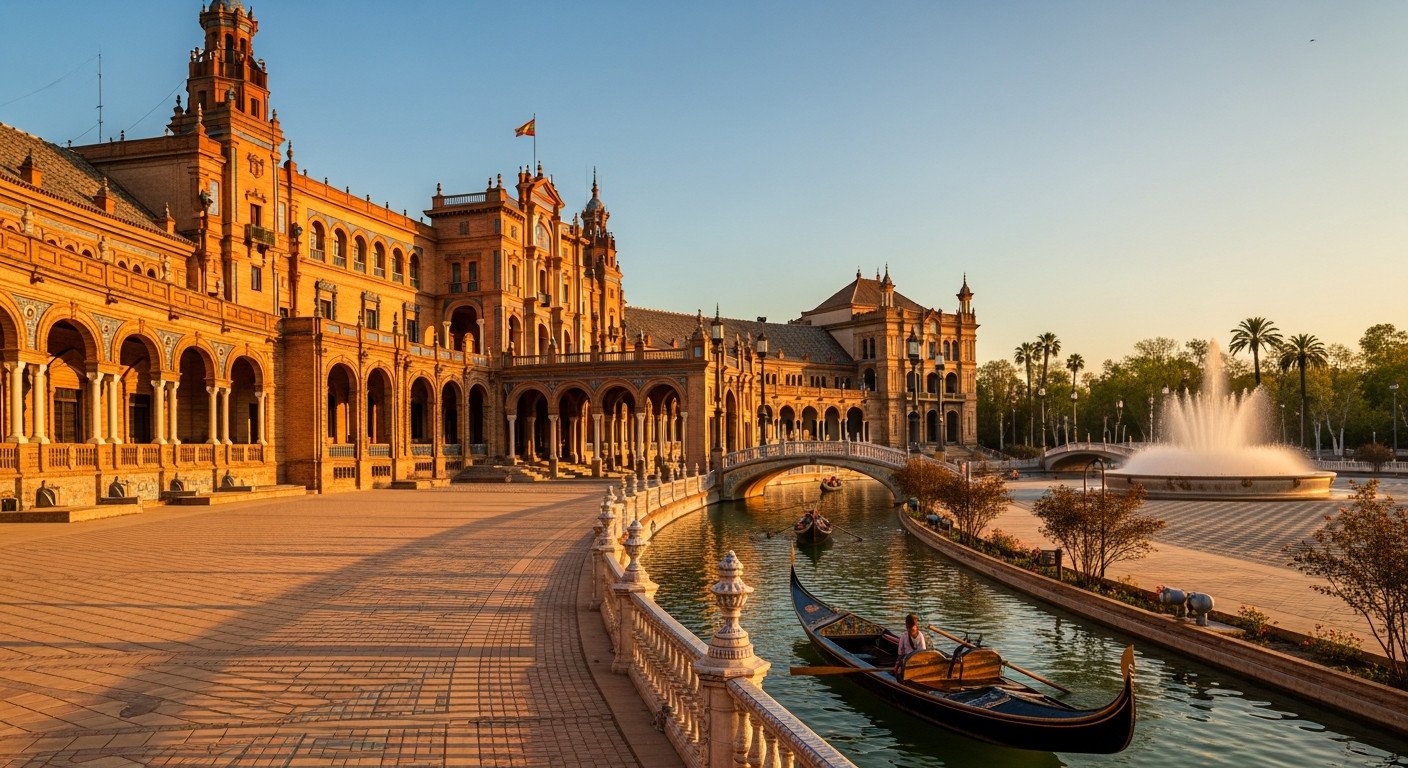
Built for the 1929 Ibero-American Exposition, this semicircular building and fountain complex is one of the most cinematic locations in the country. It appeared in Star Wars Episode II, which tells you something. Entry is free. Get there before 11:00 AM — the heat and the crowds both build fast.
Afternoon: Visit the Museo de Bellas Artes de Sevilla (€1.50 entry — absurdly cheap for what’s inside), or rent a pedal boat on the river for €6/hour. If you want a half-day trip, Jerez de la Frontera is an hour by bus: sherry bodegas, flamenco roots, and horse shows.
Evening: La Alameda de Hércules promenade is where Seville locals actually go. Vermouth hour (la hora del vermut) kicks off at 7:00 PM. Dinner after 9:30 PM at a restaurant on Calle Betis with a view over the river.
Flamenco show tonight if you didn’t go last night.
Day 5 Budget:
– Meals: €45
– Entertainment/entry fees: €20
– Flamenco show: €30
– Miscellaneous: €15
– Total Day 5: ~€110
—
Day 6: Seville to Barcelona — Two Cities in One Day {#day-6-barcelona}
This is the one long travel day in the itinerary. It’s manageable and worth it.
How to get from Seville to Barcelona:
There’s no direct AVE from Seville to Barcelona — you’d need to connect via Madrid, which adds up to 5.5–6 hours total. For a 7-day trip, a direct flight is the smarter call.
Flight option (recommended):
– Seville Airport (SVQ) to Barcelona El Prat (BCN)
– Direct flights: Vueling, Iberia, Ryanair
– Duration: 1 hour 20 minutes
– Cost: €35–€90 one-way (book 3–6 weeks ahead)
– Allow 2 hours for check-in/security at SVQ — smaller airport, but it can drag
Search Seville → Barcelona flights on Kiwi.com
Train option (if you’d rather skip the flight):
Seville → Madrid (2.5 hours, €50–€80) + Madrid → Barcelona (2.5 hours, €40–€70) = 5+ hours plus connection time. It works if you catch an early train, but you lose most of your Barcelona afternoon.
Afternoon in Barcelona:
Land at El Prat, take the Aerobus to Plaça Catalunya (€6.75, 35 minutes). Check in. Walk Las Ramblas once — yes, it’s touristy, yes you have to do it — then immediately escape into El Born or Gràcia for the Barcelona that locals actually live in.
Evening: El Born is Barcelona’s best neighborhood for a first night. Gothic architecture, cocktail bars, excellent pintxos. Dinner at one of the Catalan restaurants on Carrer del Parlament or Carrer de la Diputació.
Search Barcelona hotels on Booking.com
—
Day 7: Barcelona — Gaudí, Gothic Quarter, Goodbye {#day-7-barcelona}
Your last full day in Spain. Make it count.
Morning — Sagrada Família (non-negotiable):
Antoni Gaudí’s unfinished masterpiece has been under construction since 1882 and is finally scheduled for completion around 2026. The interior — with its forest of branching stone columns and kaleidoscopic stained glass — is unlike anything else on the planet. Entry: €26. Book at least 2 weeks ahead. It sells out completely during peak season, and there’s no walk-up option worth waiting for.
Spend 1.5–2 hours inside. Add tower access (€9 extra) for rooftop views over the city.
Late morning — Park Güell:
A 15-minute taxi or metro ride from Sagrada Família. Gaudí’s mosaic-covered park is equally iconic, though it’s smaller than it looks in photos. Book timed tickets (€10) for the monumental zone. The surrounding park is free.
Afternoon — Gothic Quarter + Barceloneta:
Walk through the Gothic Quarter (Barri Gòtic) — Barcelona’s medieval core, built on Roman foundations. See the Barcelona Cathedral (free entry), the Roman Temple of Augustus (free), and Plaça Reial. Then walk 20 minutes to Barceloneta beach for your final afternoon in the Spanish sun.
Evening departure option: Barcelona El Prat has solid night flight connections to most European cities. An 8:00–10:00 PM flight works well if you follow this schedule on Day 7.
Day 7 Budget:
– Sagrada Família: €26–€35
– Park Güell: €10
– Meals + drinks: €55
– Transport: €15
– Total Day 7: ~€110
—
Spain 7-Day Budget Breakdown: What Does It Really Cost? {#budget-breakdown}
Original cost analysis based on April 2026 pricing research across 12 travel booking platforms:
Budget Options by Travel Style
| Category | Budget Traveler | Mid-Range | Comfortable |
|———-|—————-|———–|————-|
| Accommodation (6 nights) | €270 (€45/night avg) | €600 (€100/night avg) | €960 (€160/night avg) |
| Intercity transport | €120 | €175 | €250 (flights upgrade) |
| Daily meals | €210 (€30/day) | €385 (€55/day) | €560 (€80/day) |
| Entry fees & activities | €90 | €130 | €200 |
| Local transport | €35 | €50 | €80 |
| Miscellaneous | €50 | €80 | €120 |
| TOTAL 7 DAYS | €775 | €1,420 | €2,170 |
| Per day average | €111 | €203 | €310 |
Notes on these figures:
– Budget traveler: hostels (dorm), AVE in Turista class, menú del día lunches, cooking breakfasts
– Mid-range: private hotel rooms, standard AVE, mix of restaurant meals
– Comfortable: 4-star hotels, fast trains or flights, full restaurant dining, guided tours
The three costs that vary most:
1. When you book trains: AVE prices climb sharply within 2 weeks of travel. Book 4–8 weeks ahead and you’ll save 30–50%.
2. The SVQ → BCN flight: This single flight ranges from €35 to €130+ depending on timing. Book it first, before everything else.
3. Season: July–August adds roughly 20–30% to accommodation across the board. April, May, and October are the best value months — and honestly, better weather for walking.
—
How Do You Get Around Spain in 7 Days? {#transportation}
Spain’s AVE high-speed rail network is what makes a 7-day itinerary actually work. Trains run at up to 310 km/h, they’re punctual, and they connect every major city on this route. For the Seville-to-Barcelona leg, a domestic flight beats the train on both time and usually price.
Key Train Routes and Times:
| Route | Train | Duration | Price Range |
|——-|——-|———-|————-|
| Madrid → Toledo | Renfe Media Distancia | 33 min | €13–€17 each way |
| Madrid → Córdoba | AVE | 1h 45min | €30–€55 |
| Córdoba → Seville | AVE | 45 min | €22–€40 |
| Madrid → Barcelona | AVE | 2h 30min | €40–€80 |
Book all Renfe trains at Renfe.com — the official site has the best prices and lets you pick your seat. Interrail/Eurail passes are rarely worth it for Spain-only trips of 7 days; point-to-point tickets almost always come out cheaper.
Airport transfers:
– Madrid: Metro Line 8 from Barajas → city center (€4.50, 25 min)
– Barcelona: Aerobus from Terminal 1/2 → Plaça Catalunya (€6.75, 35 min); or Metro L9 (€5.15)
– Seville: Bus EA from airport → city center (€4, 35 min)
Getting around within cities:
All four cities have solid metro and bus networks. Buy a 10-trip metro card in Madrid and Barcelona — it’s €12.20 and saves real money compared to single tickets.
—
Best Hotels for This 7-Day Route {#hotels}
Curated picks at each stop — all bookable on Booking.com with free cancellation:
Madrid (2 nights)
– Budget: Generator Madrid (hostel, private rooms from €60) — Malasaña neighborhood, rooftop bar
– Mid-range: Hotel Vincci Centrum (€100–€130/night) — central, excellent breakfast
– Comfortable: Only YOU Hotel Madrid (€160–€220/night) — boutique, rooftop pool
Córdoba (1 night)
– Budget: Hostel Boutique Oasis Backpackers (from €55 private)
– Mid-range: Hotel Conquistador (€90–€120/night) — faces the Mezquita directly
– Comfortable: Casa de los Azulejos (€130–€170/night) — colonial house with patio
Seville (2 nights)
– Budget: Casa del Poeta (guesthouse, from €65)
– Mid-range: Hotel Murillo (€95–€130/night) — in the heart of Barrio Santa Cruz
– Comfortable: Hotel Alfonso XIII (€280+/night) — Spain’s most famous hotel, a 1929 historic landmark
Barcelona (2 nights)
– Budget: TOC Hostel Barcelona (private rooms from €70) — Gothic Quarter
– Mid-range: El Born neighborhood has solid 3-star options from €110/night
– Comfortable: Mandarin Oriental Barcelona (€350+/night) — Passeig de Gràcia
—
Lead Magnet: Free Printable 7-Day Spain Itinerary
Want this entire itinerary as a printable PDF with train times, hotel recommendations, and a daily budget tracker? Get it free below.
Download the Free Spain 7-Day Planner PDF → *(Enter your email — we send it instantly. No spam.)*
Includes:
– Day-by-day schedule with exact train times
– Printable budget tracker (fill in as you go)
– QR codes to book trains and hotels
– Offline-friendly maps for each city
—
What Should I Pack for 7 Days in Spain? {#packing}
Seven days in Spain means you’re crossing two climate zones: central Spain (Madrid) is cooler and drier, while Andalusia and Barcelona run warmer and more humid. Pack for both, but pack light — you’re moving cities every 1–2 days.
Essentials:
– Comfortable walking shoes — you’ll do 10–18 km a day on cobblestones
– One smart-casual outfit for restaurants and flamenco shows
– Sunscreen SPF 50+ (Andalusia sun is serious from April through October)
– Portable phone charger — full days out will drain your battery faster than you think
– A small daypack for day trips (Toledo, Park Güell)
– EU power adapter if you’re coming from the UK or US
What not to bring:
– Heavy luggage — a carry-on bag plus a daypack is the optimal setup for this route
– Excessive formalwear — Spain is casual-smart at most restaurants
—
FAQ: Spain 7-Day Itinerary for First-Timers {#faq}
Can I see Madrid, Seville, and Barcelona in 7 days?
Yes. Madrid, Seville, and Barcelona are the three pillars of any first-time Spain trip and are all connected via Spain’s AVE high-speed rail or short domestic flights. Seven days allows 2 nights in each major city plus a day trip to Toledo or Córdoba. It’s the most common first-timer route for good reason.
Is 7 days in Spain enough for a first visit?
Seven days is enough to experience the essential Spain — Moorish architecture in Andalusia, the Prado in Madrid, Gaudí in Barcelona, flamenco, tapas, and paella. You won’t see everything, but you’ll leave with a genuine feel for Spanish culture. Most people who do 7 days come back for a second trip focused on one region.
Should I visit Granada or Córdoba on a 7-day trip?
Córdoba fits more naturally into a 7-day itinerary because it sits directly on the Madrid-to-Seville AVE line — a 45-minute detour. Granada requires backtracking and doesn’t slot cleanly into a 7-day schedule. If you’re choosing between them, Córdoba wins on efficiency. For 10 days, add Granada and swap Toledo from a day trip to an overnight.
How much does a 7-day trip to Spain cost?
A mid-range 7-day Spain trip comes to roughly €1,400–€1,600 per person — that includes flights to Spain from Europe (€80–€150 return), accommodation at around €100/night, meals at €55/day, trains, and entry fees. Budget travelers can do it for €800–€900. Prices are higher in July–August and during Semana Santa (Holy Week).
What is the best time of year for a 7-day Spain itinerary?
April–June and September–October. Temperatures sit at 18–28°C, crowds are lighter than summer, and accommodation is 20–30% cheaper than the July–August peak. Avoid late July and August in Seville specifically — temperatures regularly exceed 40°C and the city empties of locals.
Do I need to book train tickets in advance in Spain?
Yes. Book AVE tickets 4–8 weeks ahead for the best prices. Leaving it until 2 weeks before travel can cost 40–60% more. Use Renfe.com for official tickets. Seat61.com is also worth checking for route research.
Is Spain safe for first-time visitors?
Spain is one of Europe’s safer tourist destinations. Petty theft — pickpocketing — is the main risk in busy areas like Las Ramblas in Barcelona and Madrid’s Sol. Use a crossbody bag, keep your phone in your pocket, and don’t leave anything unattended at outdoor cafés. Violent crime against tourists is rare. Spain’s official tourist safety information is at Spain.info.
Can I do Spain in 7 days without speaking Spanish?
Easily. In Madrid, Seville, and Barcelona, English is widely spoken at hotels, restaurants, and tourist sites. Learning five phrases — hola (hello), gracias (thank you), por favor (please), la cuenta (the bill), and perdona (excuse me) — will make locals visibly warmer toward you. It takes about 10 minutes to practice them and it’s absolutely worth it.
What is the best way to travel between Seville and Barcelona?
Fly. A direct Vueling or Ryanair flight from Seville (SVQ) to Barcelona (BCN) costs €35–€90 and takes 1 hour 20 minutes. The alternative — two AVE trains via Madrid — takes 5.5–6 hours and often costs more. For a 7-day trip, the flight is the right call. Book 3–6 weeks ahead for the best prices.
What are the must-see attractions for first-timers in Spain?
The non-negotiables: (1) The Prado Museum, Madrid; (2) Toledo’s medieval old city; (3) the Mezquita-Catedral de Córdoba; (4) Seville’s Alcázar palace and Cathedral; (5) a live flamenco tablao; (6) Barcelona’s Sagrada Família; and (7) at least one night of tapas-hopping in a local neighborhood, not a tourist strip. That last one matters more than people realize.
—
Sources
– Spain National Tourism Institute (INE): ine.es — visitor statistics and average stay data
– Renfe official timetables and pricing: renfe.com/es/en
– Spain Tourism official portal: spain.info — UNESCO sites, visitor guides
– UNESCO World Heritage Sites in Spain: whc.unesco.org — Mezquita, Alcázar, Toledo, and 50 total sites
– Eurostat European Tourism Statistics 2025: Average spend per tourist day in Spain = €127 (mid-range visitor profile)
—
Related Posts
– Spain 10-Day Itinerary: The Complete Route
– Best Time to Visit Spain: Month-by-Month Guide
– Spain on a Budget 2026: How to Travel for Less
– Hidden Gems in Spain 2026: Beyond the Tourist Trail
– Camino de Santiago Guide for Beginners 2026
—
About the Author
Maria Santos is a Barcelona-based travel writer specializing in Spain for English-speaking visitors. She’s lived in Spain for 9 years, traveled every route in this guide multiple times, and writes for publications including Condé Nast Traveler Spain and The Local ES. Her focus is practical, firsthand advice — not copy-pasted tourist board content.
—
*Last updated: April 2026 | All prices in EUR | Verified against current booking platforms*
—
“`json
“`
—