Camino de Santiago Travel Guide 2026: Routes, Tips, and What Nobody Tells You
Disclosure: Some links in this article are affiliate links. We may earn a small commission at no extra cost to you. We only recommend accommodations and services we genuinely trust.
The Camino de Santiago changes you before you even realize it’s happening. My legs knew before my mind did — somewhere between Burgos and León, on Day 17 of the Camino Francés, when the horizon stretched into golden meseta and the only sounds were my footsteps and wind through the wheat, I understood why nearly 500,000 pilgrims walk this route every year. This guide covers everything you need to know for the Camino de Santiago in 2026: which route to choose, where to sleep, what to pack, and what nobody warns you about before you go.
The Moment That Started It All
I’d been sitting at my desk in Madrid, three years into a job I’d outgrown, when a colleague showed me a photo: the iron Cruz de Ferro cross on a windswept hillside, surrounded by stones left by pilgrims from every country on earth. Each stone carried a burden someone had decided to put down. I booked flights to Saint-Jean-Pied-de-Port the same afternoon.
That decision led me to one of the most physically demanding, spiritually surprising, and unexpectedly joyful things I’ve done. The Camino is not a hike. It’s not a yoga retreat. It’s not Instagram content, though you’ll take more photos than you can believe. It’s 30-plus days of walking through medieval villages, eating bocadillos with strangers from Seoul and São Paulo, discovering that blisters and communal dining tables share more than just a connection to your feet, and arriving at Santiago de Compostela Cathedral more changed than you expected.
Here’s what you need to know to make it happen in 2026.
Choosing Your Route: 6 Caminos Compared
The “Camino” is not one path — it’s a network of pilgrimage routes converging on Santiago de Compostela in northwestern Spain. In 2024, 499,242 pilgrims received the Compostela certificate, according to the Pilgrim’s Reception Office (Oficina del Peregrino). The route choice defines your entire experience.
| Route | Distance | Days | Difficulty | Best For |
|---|---|---|---|---|
| Camino Francés | 780 km | 30–35 | Moderate | First-timers, social atmosphere |
| Camino Portugués | 240 km (Porto) | 10–14 | Easy-Moderate | Shorter trip, Atlantic coast |
| Camino del Norte | 820 km | 35–40 | Hard | Experienced walkers, coastal scenery |
| Camino Primitivo | 320 km | 12–15 | Hard | Mountains, solitude, original route |
| Camino Inglés | 120 km | 5–7 | Easy | Short holiday, budget-limited time |
| Vía de la Plata | 1,000 km | 40–50 | Very Hard | Experienced pilgrims, hot summers |
My recommendation for first-timers: The Camino Francés is the classic for a reason. The infrastructure is unmatched, the community of pilgrims (the “Camino family” you’ll build over weeks) is densest, and the towns — Pamplona, Logroño, Burgos, León — are extraordinary in their own right. If you only have 10 days, consider the final 115 km from Sarria to Santiago, which still earns you the Compostela.
When to Walk: The Best Time for Camino 2026
The month you walk determines everything from blister risk to the number of people sharing your albergue bunk room.
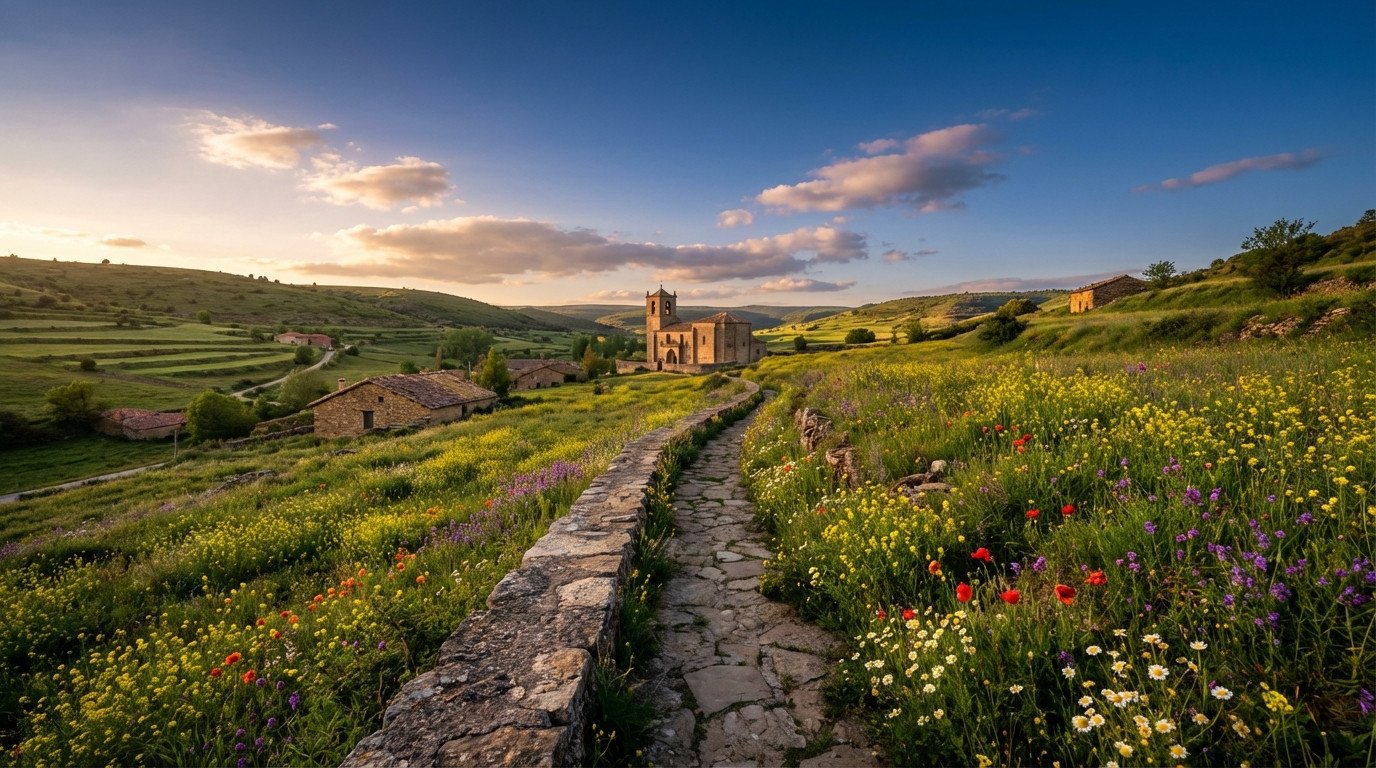
May and June are the sweet spot. Temperatures are mild (15–22°C on the meseta), wildflowers cover the hillsides, and the crowds haven’t yet peaked. Albergues have availability without feeling deserted. September and October offer equally pleasant weather with the bonus of harvest season — wine region stages through La Rioja in October are unforgettable.
Avoid July and August if you can. The meseta reaches 38–40°C, the Camino is at maximum capacity (Sarria to Santiago feels like a motorway of pilgrims), and albergue queues form at 2 PM. That said, if July is your only window, go — the heat is manageable with early starts (leaving at 6 AM before sunrise is common practice).
Winter walking (November–February) is a different experience entirely: raw, quiet, atmospheric. Many albergues close, requiring advance planning, and the Pyrenees crossing from Saint-Jean can be closed by snow (an alternate lower route via Valcarlos exists). For those seeking solitude and a meditative experience, the off-season is genuinely beautiful.
Where to Sleep: The Albergue System Explained
Albergues are pilgrim-only dormitory hostels that form the backbone of Camino logistics. They come in three types, and understanding the differences saves money and frustration.
Municipal (public) albergues: Run by local government, cost €10–12/night, cannot be booked in advance (first-come, first-served). Arrive before 2 PM in summer to guarantee a bunk. Require your pilgrim passport (Credencial) for entry.
Parochial albergues: Run by the Catholic Church or volunteer confraternities. Often €10–15, sometimes donation-based. Many offer a communal pilgrim meal and evening blessing. These are among the most atmospheric places to sleep on the Camino.
Private albergues: €15–25, can usually be booked in advance via Booking.com or Airbnb. Have smaller dorms (6–12 beds vs. 50–100 in public albergues), better bathrooms, and WiFi. Highly recommended for the Pyrenees crossing stage and for anyone with back problems who needs a lower bunk guarantee.
For accommodation planning, check availability on Booking.com’s Camino properties for the private albergues that allow advance booking along the Francés.
The Pilgrim Passport: Getting Your Credencial
The Credencial del Peregrino is your official pilgrim passport — a folded paper document you carry throughout the journey, collecting stamps (sellos) at albergues, churches, cafés, and municipal offices along the way.
Where to get it: Buy one for €2–5 at the pilgrim office in Saint-Jean-Pied-de-Port (or your starting city). You can also order one in advance from your local Camino Association (most countries have one) before leaving home.
Why you need it: Municipal and parochial albergues only admit pilgrims with a valid Credencial. You also need it to receive the Compostela at the Pilgrim Office in Santiago — you’ll need at least two stamps per day for the final 100 km of your journey, per the 2025 rule update from the Archdiocese of Santiago.
The Compostela: The official certificate awarded upon completion. Since 2025, the minimum qualifying distance is any 100 km of an official route, ending in Santiago. For the full Francés from Saint-Jean, you need 35+ days of stamps.
What to Pack: The Pilgrim’s Rule of 10%
The cardinal rule of Camino packing: your backpack must weigh no more than 10% of your body weight. For a 70 kg person, that’s 7 kg total — pack, gear, and all. This sounds brutal. It’s not negotiable.
The essential list:
- Backpack: 30–40L with rain cover. Don’t bring 50L thinking you’ll fill it less — you will fill it.
- Footwear: Trail runners (broken in, not new) plus flip-flops for albergues. DO NOT walk in new boots on Day 1.
- Clothing: 2–3 quick-dry shirts, 2 hiking pants/shorts, 3 pairs of Merino wool socks (game-changing for blisters), 3 moisture-wicking underwear, one warm layer.
- Sleeping: Lightweight silk sleeping bag liner (albergues provide beds but not always blankets).
- Medical: Compeed blister plasters, ibuprofen, electrolyte tablets, sunscreen. Your pharmacist on the Camino becomes your best friend — every village has one and they’ve seen every Camino injury.
- Documents: Credencial, passport, travel insurance card, emergency contacts.
The Towns You’ll Fall For
Walking the Camino Francés is a 780-km tour of medieval Spain. These are the towns pilgrims remember longest:
Pamplona: Home to the Running of the Bulls (July) and a stunning old city that Ernest Hemingway immortalized. The medieval walls and pintxos bars in the old town are worth a rest day.
Logroño: Spain’s wine capital for La Rioja wines. The Calle Laurel is one of Spain’s great tapas streets. Pilgrims who arrive on a Friday can’t believe their timing.
Burgos: Home to one of Spain’s greatest Gothic cathedrals. The Burgos Cathedral (UNESCO-listed) stops pilgrims cold in the middle of the street.
León: The stained glass windows in León Cathedral are among the finest in Europe — the whole interior glows with colored light on a sunny morning.
Sarria: The last town to start the Camino and earn the Compostela. From here to Santiago is 115 km — the Camino’s most walked stretch.
Santiago de Compostela: The endpoint. The Pilgrim Mass at noon in the cathedral, the smell of incense from the Botafumeiro (a giant swinging censer), and the moment you touch the statue of Saint James — after 30 days on foot, this is genuinely overwhelming. Plan to spend at least two nights in Santiago. For accommodation in the city, search Booking.com for Santiago — the Parador de Santiago, built in 1499 as a royal pilgrim hospital, is one of the world’s most atmospheric places to celebrate a Camino finish.
Practical Information: Budget, Safety, and Transport
Daily budget: €35–55/day covers a bunk in a private albergue, meals (the Pilgrim Menu — 3 courses + wine for €12–14 — is everywhere on the Camino), and coffee. Budget walkers staying in municipal albergues and cooking occasionally can manage €25–35/day.
Safety: The Camino is extremely safe. Women walk solo routinely — per the Pilgrim Office’s 2024 data, 54% of pilgrims are women. The pilgrim community is self-policing, albergues have security, and the route is well-signposted with yellow arrows (flechas amarillas) throughout.
Getting there: Fly into Biarritz (closest airport to Saint-Jean-Pied-de-Port) or Pamplona for the Francés start. Porto Airport is the gateway for the Portuguese route. Santiago de Compostela has its own international airport for the return.
For more on Spain travel planning, our Spain travel tips guide covers logistics that apply beyond the Camino, and our 10-day Spain itinerary shows how to combine the Camino finale with other Spanish destinations. And if you’re heading south after arriving in Santiago, the San Sebastián travel guide is worth reading for a very different kind of Spanish food experience.
Frequently Asked Questions
How long does it take to walk the Camino de Santiago?
The most popular route, the Camino Francés (780 km from Saint-Jean-Pied-de-Port), takes 30–35 days walking an average of 22–25 km/day. The minimum qualifying distance for the Compostela certificate is 100 km on foot, which takes 5–7 days from Sarria.
Do you have to be religious to walk the Camino?
No. According to the Pilgrim Office’s 2024 statistics, fewer than 40% of pilgrims cite purely religious motivation. Most pilgrims walk for spiritual, personal, physical, or vacation reasons. The Compostela (official certificate) is awarded for religious/spiritual purposes; non-religious pilgrims can request the “Welcome Certificate” instead.
How much does the Camino de Santiago cost?
A full Camino Francés from Saint-Jean costs approximately €1,100–1,800 for accommodation and food (30–35 days at €35–50/day). Flights, gear, and insurance add €300–600. Budget pilgrims who use municipal albergues exclusively and cook can do the full route for under €1,000.
Is the Camino de Santiago safe for solo female travelers?
Yes — 54% of pilgrims are women according to 2024 Pilgrim Office data, and a significant portion travel solo. The albergue system creates a built-in community, yellow arrow waymarking minimizes getting lost, and the pilgrimage culture is one of mutual support.
What is a pilgrim passport (Credencial)?
The Credencial del Peregrino is a paper document that proves your pilgrim status and serves as a stamp collection card. You need it to stay in public albergues and to receive the Compostela certificate in Santiago. Purchase one for €2–5 at the starting point pilgrim office or from your national Camino association.
When is the best time of year to walk the Camino?
May, June, September, and October offer the best combination of mild weather, open services, and manageable crowds. July and August are peak season with extreme heat on the meseta (38–40°C) and maximum pilgrim traffic.